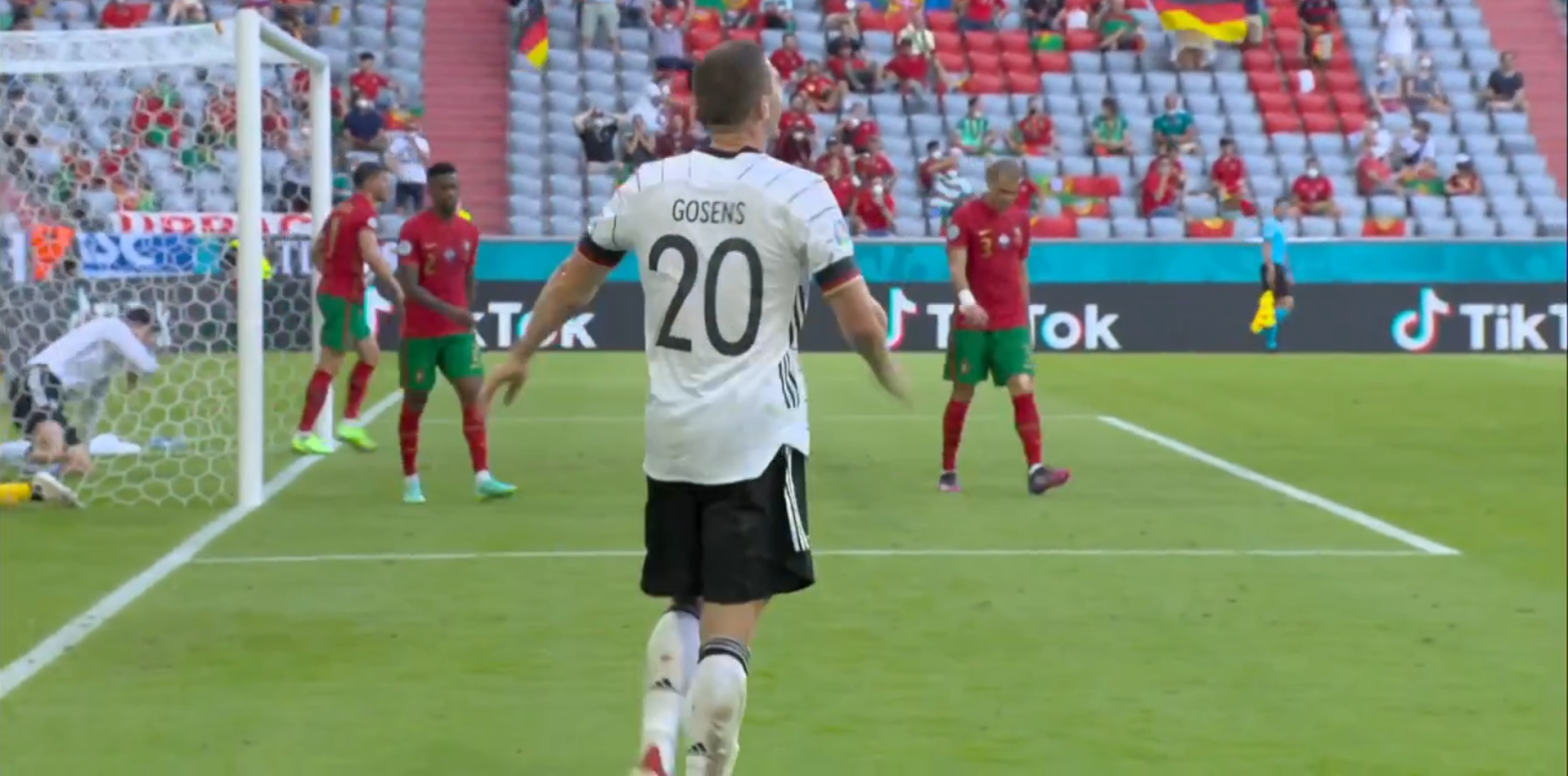
Going into Euro 2020, many people predicted a disappointing campaign for Germany and a campaign as tournament favourites for Portugal. Yesterday, we saw a result that reflected the opposite. Germany now look like they could go far this Summer, and Portugal might not even make it out of the group stage should France have anything to say about it on Wednesday. Portugal scored a fantastic goal on the counter and a chaotic goal from a set piece. Germany’s four came from unlocking Portugal’s defence after figuring out they’d have to win the game on the flanks.
Once again, Fernando Santos got the midfield balance completely wrong, but this time they weren’t as lucky as they were against Hungary. The story in that game was the extremely pragmatic double pivot of Danilo Pereira and William Carvalho. Yesterday, Santos made the slightest of changes by switching to a midfield three with Pereira sitting just in front of the back four, Carvalho ahead to his left, and Bruno Fernandes ahead to his right. The instructions changed, but the tendencies stayed the same. At the smallest scent of danger, Pereira dropped back into the defensive line to form a back five. Carvalho offered little going forward, generally hung back on attacks, and took up very central areas of the pitch. Pereira and Carvalho together offered the same as they did against Hungary—extra defensive cover with little attacking contribution—but just in slightly different positions.
Fernandes, now operating as a deeper 8 compared to his role as a free 10 against Hungary, was a non-factor yesterday. With this 8 role, he was forced to have more positional discipline as in theory, Carvalho would be operating on the left side of the pitch. This wouldn’t be a problem if Portugal had a conventional winger on the right and Carvalho offered something going forward. With Bernardo Silva playing at right-wing, there was no out ball on the right. Bernardo, a natural central playmaker, tends to want to drift inside to influence the game. Bernardo and Fernandes were bound to occupy much of the same space on the right channel—and they did. Bernardo was yanked off for Renato Sanches at halftime, and a very knackered looking Fernandes ended his night in the 58th minute with Rafa Silva taking his place.

Though Portugal had 43% of the possession over the entire game, they only had 38% in the first half, and their second half 47% possession is skewed by their late push for a goal against a Germany that were content with sitting deep and clearing balls. Portugal very much played on the counter because despite having the three to two man advantage in midfield, they basically played like they had 1.5 to Germany’s two.
Portugal’s first goal was brilliant. It was what many called a perfect counter attack. It was quick, incissive, and ended with the ball at the back of the Germany net. Cristiano Ronaldo almost ran the entire length of the pitch to score after making the clearing header that started the attack off. Portugal’s second goal was absolute chaos. It came from a free kick that looked like it’d end up as a goal kick for Germany, but with some Ronaldo “never say die” magic and a ball watching Germany defence, Portugal scored the scrapiest of scrapy goals.
If Ronaldo’s clearance on the first goal doesn’t land near Bernardo with acres of space and Germany aren’t left dazed by a ball they assumed would go out of play, Portugal would’ve left the Allianz Arena goalless and even more worried than they are now. The match report shows assists from Cristiano Ronaldo and Diogo Jota, but they should add in parentheses “Lady Luck”.
Germany’s issue with their squad is a complete lack of a standout central playmaker. Germany have a wealth of attacking talent with diverse skill sets, but don’t have a Bruno Fernandes or Bernardo Silva type player that can create a chance out of half a chance, or play the final pass for a teammate to score. Players like Serge Gnabry, Kai Havertz, and Leroy Sané are multi-faceted forwards that can carry the ball well, take on defenders out wide, and make runs beyond the opposition back line. Players like Thomas Müller, İlkay Gündoğan, and Leon Goretzka are industrious and intelligent midfielders that will always look to make late runs into the box to score. In Toni Kroos, Germany have a pass master midfielder who will dictate the tempo of the game, but prefers to create chances from deep as opposed to from positions higher up the pitch.
The lack of a central playmaker meant a lack of penetration from central areas. Oftentimes against Portugal, Gnabry, Havertz, or Müller would receive the ball and try to work something in the channels, but only to end up pulling it back to be intercepted by a Portugal defender, or have their cross blocked. There wasn’t a lot of cohesion between the front three when one of them had the ball, and they looked at times like they were just doing their own thing. With Portugal essentially playing a back five out of possession and loading up the deep central areas of the pitch, Germany weren’t going to get anything through the middle.
So, they stopped trying to. Instead, Germany used their best creator on the pitch, Joshua Kimmich, and exploited the mismatch on the flanks. The hardest part about defending against a back three system with a back four system is knowing who to defend. It’s even harder when it’s a 3-4-3 or 3-4-2-1 because including the wide centre-back, there could be three players bombing forward on a flank. Antonio Rüdiger, a capable ball carrier, often brought the ball forward to initiate the attack like he did to start the play that ended with the Raphaël Guerreiro own goal. When defending against a back three with a back four, the full-back and winger have to coordinate who to mark, but also the closest midfielder has to help out on the wing if a third attacker is making a run down that side. Portugal didn’t have that help on their left side because of how central Carvalho was playing. This created tons of space for Kimmich to whip balls to the opposite side where Robin Gosens was constantly left unmarked. Germany shifted Portugal’s defence to the right knowing Kimmich would likely have a lot of space to operate anyways, which created space for Gosens to run into and confusion at the back with regards to who was supposed to mark him.
Here on Germany’s fourth goal, Gnabry occupies Pepe and Rúben Dias at the near post while Havertz makes a smart late run into the box to pull Nélson Semedo away from the back post. Gosens is left unmarked because Rafa Silva (#15 behind Gosens) half-heartedly tracked Gosens’ run—half-heartedly being a generous way of describing his effort.

Including Germany’s disallowed goal ruled for offside, they created all their scoring chances by switching the ball from one flank to the other. For all four goals, Kimmich and Gosens made the assist, made the pass that led to the assist, or in the case of the fourth goal, scored it. Germany very astutely solved the puzzle of Portugal’s compact backline by attacking their weak wing defence. Working the ball from flank to flank very quickly, Portugal had no answer at all. In a low-scoring sport where luck is an immense factor, Portugal didn’t have enough of it to compensate for their poor tactics. Germany will likely have issues later on in the tournament with their lack of central creativity, but Portugal’s reliance on luck and chance will cause them even more issues and sooner.
 The Utility Spot