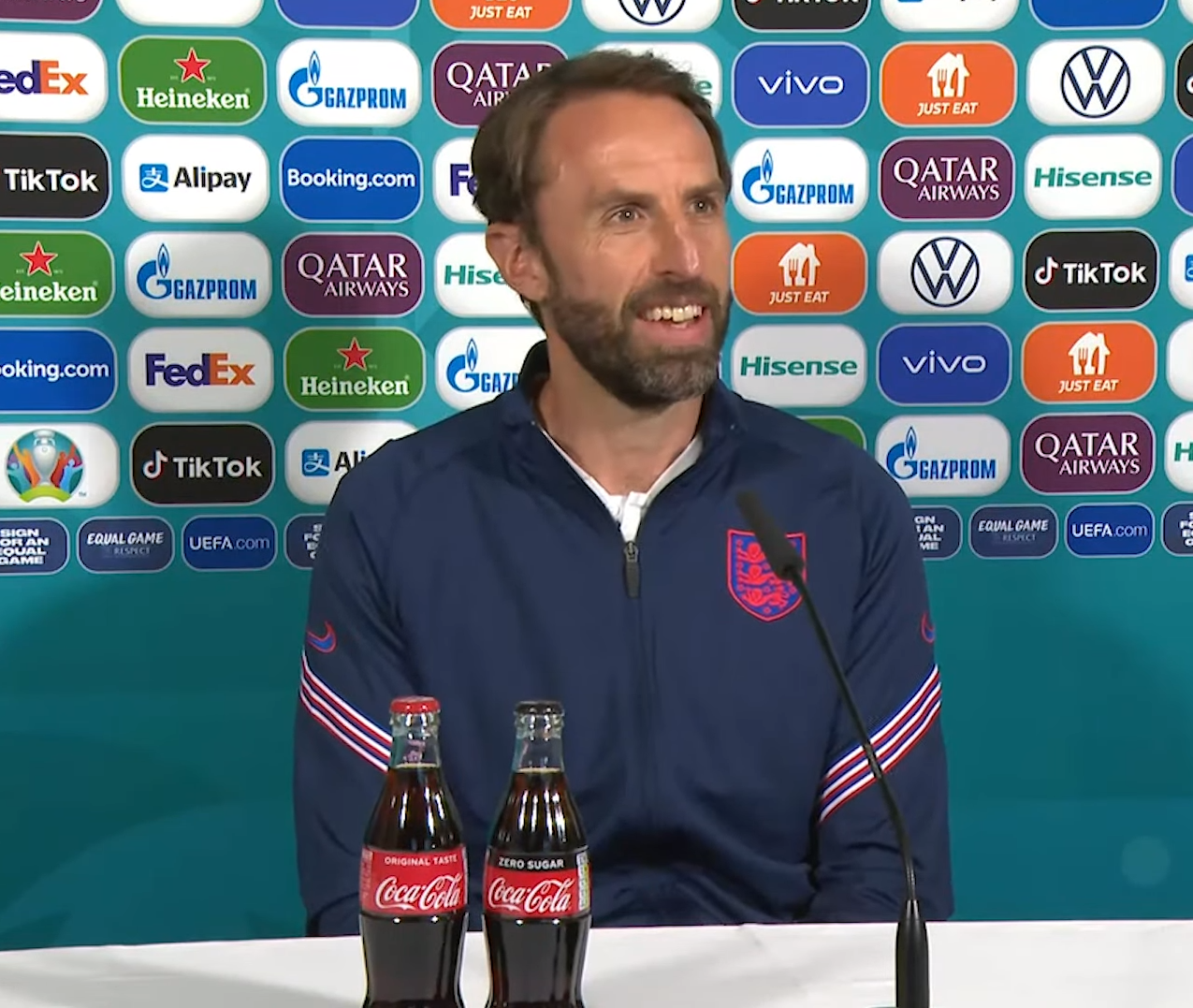
After 55 years of disappointment and shortcoming, England have returned to a major international final. 13 permanent managers and 27 major international tournaments later, England once again have the opportunity to lift major silverware. This opportunity comes with the Three Lions being led by a polarizing figure, Gareth Southgate.
Southgate has always been a natural leader. He captained Crystal Palace and Middlesbrough during his playing days and as manager, led England to a fourth place finish in the 2018 World Cup and a third place finish in the 2018-19 Nations League. Yet, he’s been constantly criticized his entire career.
Many blame Southgate for England’s semi-final exit at Euro 96. Yes, he missed the penalty in the shootout that sent England packing, but penalty shootouts involve much more luck than the already luck dependent 120 minutes that precede it. Many also blame Southgate’s pragmatism for England’s loss to Croatia at the 2018 World Cup. The 3-5-2 he deployed and the subs of Danny Rose and Eric Dier in extra time turned England fans off. After England flew back home from Russia, there were calls for Southgate’s sacking. Despite the outrage from fans and media alike, the FA stuck with him and their decision is paying off.
The success England has achieved so far at Euro 2020 can be largely attributed to Gareth Southgate’s understanding of international tournament football. Unlike club football, teams have little time to prepare together before the tournament. International breaks during the domestic season are spread out and sparse with players coming in and out of the team. On top of the little time to prepare, teams play every 4-5 days in the tournament.
To combat this issue, Southgate has kept things simple in his tactical approach. He hasn’t tried to apply convoluted tactics that would easily be forgotten or break down mid-match. For example, pressing triggers have often been reduced to the moment the ball goes to the opposing defenders that aren’t as good on the ball. This allows the team to keep their shape and not be drawn out of position.
Southgate’s also managed to keep the squad fresh throughout a tournament where they’ll have played seven matches in 29 days. There hasn’t been a single injury during a match. The only injuries England sustained were Dean Henderson and Trent Alexander-Arnold in training. Training sessions have been mostly classroom sessions and iPad tactical work, with the majority of physical exertion left for matches.
Despite the commotion around calling up four right-backs, all three that were available were used, and in a variety of positions like Southgate mentioned was possible. Kyle Walker’s been one of England’s best players in the tournament playing on the right and in a back three. Kieran Trippier’s been used on both flanks. Reece James put in a very good shift at right-back against the dynamic left-back duo of Scotland’s Kieran Tierney and Andy Robertson.
Southgate’s game management has been astounding too. In attack, only Harry Kane and Raheem Sterling have started every game. Southgate’s rotated the other attacking positions with the wealth of creative players at his disposal. Foden, Mount, Grealish, Saka, Sancho, Rashford, and Calvert-Lewin have all had moments to influence a game—the first five given starting berths.
In defence, only John Stones and Jordan Pickford have started every game. You could argue had Harry Maguire been fit earlier in the tournament, he would’ve started every game as well, but Southgate could’ve easily rushed him back and yet he didn’t.
The continued midfield partnership of Declan Rice and Kalvin Phillips has been defensive, but effective nonetheless. It’s been a large reason why England have only conceded one goal the entire tournament—a world class Mikkel Damsgaard free kick. Rice and Phillips have both had to do lots of running, and Southgate has smartly subbed Rice off in four of the six matches and subbed Phillips off in one—though Phillips is a world class athlete as evidenced by the past season he’s had with Leeds United. Despite starting every game, Rice has only played an average of 77.5 minutes per game. Instead of running his players into the ground, Southgate has rotated forwards to keep the attack fresh and fast, and he’s rotated full-backs so they’re ready for the demanding jobs they are employed to do.
It’s no secret that many England fans hate the idea of Rice and Phillips being mostly deployed to help shore up the defence. Instead of more dynamic and buccaneering midfielders, Rice and Phillips mop up balls and drop deep to create a back five or six. As unexciting as this may be, you can’t deny its effectiveness. To not have conceded a goal from open play going into the final is a titanic feat. The truth is, an organized defence, well-rehearsed set pieces, and clinicalness in front of goal is what wins major international tournaments. In other words, pragmatism is what wins trophies. The stick fans and the media have used to beat Southgate with is exactly what has brought them to a meeting with Italy at Wembley.
Southgate’s pragmatism isn’t dreadful, “park the bus” football either. He aims to nullify one of the opposition’s biggest weapons. Against Germany, England matched Germany’s 3-4-2-1 with a 3-4-3. The German overloads on the flank we saw against Portugal were non-existent against England. Gosens was marked out of the game and constantly unavailable for the switch pass when he went up against a cohort of Saka, Trippier, and Walker.
Against Denmark in the semi-final, England once again started Saka and Walker on the right of their usual 4-2-3-1 to counter the pace of Damsgaard and Mæhle. Saka was industrious, tracking back often. Walker won every foot race with his lightning pace. James and Trippier certainly offer more going forward, but neither are as good as Walker in terms of tackling or recovery pace. The way Southgate looks to make the opposition win the game with their second or third best weapons is very Bill Belichickian.
Euro 2020 has been as much of a management masterclass for Southgate as it has been a healing process for him. The conversation around England’s campaign this Summer has always included the disappointments of Euro 96 and the 2018 World Cup. Alan Shearer wrote a heartfelt letter on The Athletic to his former England teammate on how he doesn’t blame him for his missed penalty 25 years ago. Southgate’s taken the criticism in stride and hasn’t let the noise from the fans or media affect him. He’s stuck with his style of play despite the calls for a more flair-based approach.
The demons of 25 years ago and 3 years ago have become lessons. Those demons have been slain and turned into key aspects of his approach to management. The unity in the England camp is like nothing we’ve seen before and Southgate fully understands the importance of it. He knows the scrutiny on the England national team is always extremely high. He’s faced the brunt of it before. So, he shields his players in press conferences. He always has their backs and supports them on and off the pitch. If anyone knows the mental aspect of international tournament football is as important, if not more important than the physical aspect, it’s Gareth Southgate.
England may not bring football home at Wembley, but to get to a major international tournament final after 55 years is an achievement nonetheless. To beat a young and electric Italy side on home turf would be an even greater—and attainable—achievement. With the World Cup right around the corner next year, Gareth Southgate will be the man to lead England to another good run and hopefully a trophy. Like he’s learned from his experiences of Euro 96 and the 2018 World Cup, he’ll learn from the experience of Euro 2020 and build towards an equally good, if not better 2022 World Cup. As it’s been sung across England this past month, Southgate you’re the one.
 The Utility Spot