It may seem harsh to say, but Manchester United were like a bunch of worms against Manchester City in the Derby. No, they weren’t gross or decomposing. No, they weren’t wrigley or slimy either. Comparisons could be made between the Red Devils and invertebrates, but while they lacked a backbone, they certainly weren’t cold-blooded—in attack at the very least. Before this metaphor gets redundant, my point is, Manchester United were toothless in attack and boneless in defence. Those with better knowledge on zoology, please do reach out with a better comparison from the animal kingdom.
The 3-4-1-2 Ole Gunnar Solskjær deployed in the Derby earlier this month almost instantly became a 5-2-1-2 at kickoff. Instead of the system previously effectively used against top sides that saw United’s wingbacks push high up to pin opposing wide defenders back, Aaron Wan-Bissaka and Luke Shaw dropped back in to merely add extra bodies to the backline. Instead of forcing Kyle Walker and João Cancelo to stay in their own half, Wan-Bissaka and Shaw stayed deep, and invited constant pressure from the former two and also Phil Foden on the left and Gabriel Jesus on the right. Immediately, United looked like a weak side that fielded five defenders to hole up in their shell, hoping for the best.
It’s somewhat understandable why Solskjær opted for a back five system. Going into the Derby, United had only kept two clean sheets in the league and conceded 15 goals—the most of any of the top 8 sides at the time. The team have been leaky all season long in defence and in midfield. And yet with an extra defender, United constantly looked prone to concede. In the 22nd minute, City broke with a 4 v 7 disadvantage, but they still looked like they’d score. The play ended in a corner for City, but United allowed Cancelo and De Bruyne to freely make runs down the left while United had confused bodies aimlessly in the middle of the pitch.
As moot as the point of Manchester United’s pressing problem has become, they once again looked poor in every attempt to win the ball back. Not only was United’s press ineffective in turning the ball over, the way in which they pressed made it easier for City to progress the ball as well. It looked like the players in sky blue were running a training drill to retain possession under pressure, but on easy mode. I’m not certain John Stones, Rúben Dias, and Rodri didn’t see arrows on the pitch directing them where to pass the ball when the United players were pressing in straight lines from pointless angles. A couple passing exchanges that worked the ball wide to the fullback or winger left 3-5 United players stranded up the pitch with nowhere to go but 50 yards back towards their own goal. With how easy City could break the press, they were able to keep Kevin De Bruyne and İlkay Gündoğan high up and ready to launch attack after attack. As expected, United’s pressing issues were on their fullest display against the side that’s best in the league at retaining possession.
In attack, United were as blunt as a hammer. In the 5-2-1-2 system with the wingbacks held back, United lacked any width whatsoever. Every counter was down the middle and extremely narrow against a team that notoriously defends narrow. With Mason Greenwood and Cristiano Ronaldo playing as split strikers, Bruno Fernandes’ only options were two players making straight direct runs forward. This resulted in almost every potentially dangerous counter ending in a wayward Fernandes pass, or a recycle of possession that removed any momentous advantage. The definition of insanity is doing the same thing over and over again and expecting different results.
Though United were easy to predict, City also defended well. The defenders crowded out Ronaldo and Greenwood, and the midfielders tracked back to harass Fernandes in possession and cut off any late passing options out wide. Manchester United were simply too predictable in attack. The switch from a 4-2-3-1 to a 5-2-1-2 simply changed the reason the defence was exposed as opposed to patching up the defensive issues. One fewer attacker and no wide attackers caused United to be fruitless on the counter. Unable to retain possession, the defence was continuously bombarded by City’s relentless pass-heavy attack.
Enter Jadon Sancho. The creative Englishman replaced Eric Bailly—who had an own goal under his belt—at halftime. Manchester United reverted to their more familiar 4-2-3-1 and immediately looked much more dynamic in attack with the intelligent winger on the pitch. With Sancho on the left and Greenwood now pushed to the right, United had width when attacking and actually looked dangerous. Greenwood was now able to pick up the ball from his favoured spots in the right half space and cut inside to fire shots at Ederson.
Sancho was very involved from the get-go. He was running down the flank at defenders and exchanging passes with Shaw and Fernandes. If United were to make a comeback in the game, it would’ve involved Sancho. Number 25 even got to play on his favoured right side when Marcus Rashford came on for Greenwood and slotted in on the left flank.
The burst of hope was short lived however, as Manchester City adapted to Manchester United’s changes and ground the game to a halt. Two goals to zero doesn’t paint the whole picture, as City could’ve easily scored five or six, and United would’ve faced heavy losses to rivals twice in three league games. Pep Guardiola opted for the more “Pep” approach by instructing his team to retain possession and pass the ball around, and around, and around to a dizzying effect. City slammed the brakes and the tires screeched, and Old Trafford was bleakly quiet.
I fully expect Solskjær to revert to a 4-2-3-1 for the game against Watford as they’ll be the side with more quality—by payroll and on paper. Not to mention, Bailly has likely lost any confidence from the manager and Shaw, even if fit from his concussion, has looked poor defensively this season—especially in his positioning (see his error on the Bernardo Silva goal). With Raphaël Varane still sidelined, United have few options at centre back. Nonetheless, it’s likely that back three lineups will return for United—and sooner than later, with fixtures against Chelsea and Arsenal in one and a half weeks and two weeks time, respectively. Sancho has always looked like a puzzle piece Solskjær had trouble fitting into his puzzle, but what if he’s the key piece?
There are rumours of possibilities of Sancho in a right wingback role. Wan-Bissaka’s shortcomings in attack are well documented. While his crossing has slightly improved, he’s still a non-factor in possession. Teams like Villarreal have simply allowed him to have possession freely—knowing he won’t do much with it. Sancho has surprisingly shown flashes of industry when defending in wide positions. With how dull United can look on the counter in a 3-4-1-2, and with an extra body in defence, it could be worth trying Sancho as a right wingback. He’d bring much needed creativity from that position, and more dynamic chance creation than Diogo Dalot. Of course ironically, the player that was perfect for injecting pace on the counter while providing defensive workrate was sold to Leeds United to aid the process of bringing back Ronaldo and making room for Sancho.
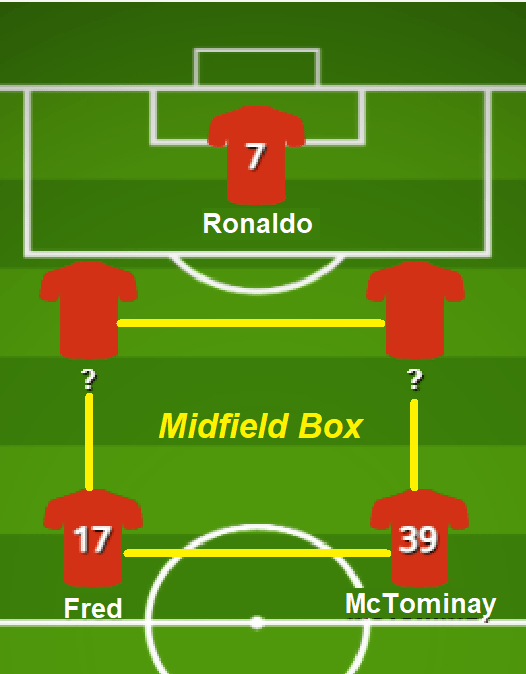
Another way Sancho could be used is as an inside right forward in a 3-4-2-1. Fernandes would be deployed as an inside left forward—similar to how De Bruyne is sometimes deployed for Belgium—and he, with Sancho and the midfield pivot, would create a midfield box. Fernandes and Sancho playing behind and to the sides of the striker would provide tons of creativity and attacking threat. The midfield box would solidify the defence and theoretically create 4 v 3 man advantages in midfield. Theoretically because this would require adequate coaching and lots of energy from Fernandes and Sancho—the former not always present.
The issue with this system is it excludes two of Ronaldo, Greenwood, and Cavani, and likely also Rashford too. With the jam packed Christmas schedule looming, however, the time to rotate the squad is now. During his time in Spain and Italy, Ronaldo has always had a Winter break, so he won’t be used to having matches every 3-4 days in December. It’s the perfect time for Ronaldo to be rested and for Cavani and Greenwood to get runs in as lone strikers, or as a pair.
Ultimately, these ideas need to hurdle the barrier that is the United’s coaching staff’s lack of tactical nous. The hope is, the condensed Winter schedule will force the team to be flexible in tactics and personnel astutely.
 The Utility Spot