There’s a quote: “the definition of insanity is doing the same thing over and over again and expecting different results”. So then what is it called when you do the same thing, but slightly different, and get a glimmer of a different result before ultimately ending up at the same conclusion?
The origin of the quote is unknown. It’s been attributed to Albert Einstein, Alcoholics Anonymous, Vaas Montenegro from Far Cry 3, among others. Like the quote, the 4-2-3-1 Manchester United deployed in successive matches now has multiple authors.
After a lack of thorough understanding of Rangnick’s famed 4-2-2-2 formation, the United interim boss reverted to the 4-2-3-1 formation the squad is much more familiar with. During Ole Gunnar Solskjær’s three year reign as Manchester United boss, they rarely deviated from the 4-2-3-1. So, the 4-2-3-1 is back.
In the two matches the formation returned, Manchester United beat Aston Villa in the FA Cup and looked very good for about 60 minutes five days later at Villa Park. Looking deeper though, United crawled to full time and looked awful for large stretches in the cup fixture, and fell apart almost as expected to drop two points in the league fixture. The positive takeaways are refreshing, but the negative takeaways are a worn out story.
Some have interpreted the formation United used against Aston Villa on Saturday as a 4-3-3 with Nemanja Matić sitting behind Bruno Fernandes and Fred, but the exact formation isn’t as important. What IS important to note is the attack was once again centred around Bruno, and every attacking play involved some piece of creativity from the Portuguese playmaker. The 4-2-3-1 Solskjær deployed was less about the “4”, the “2”, the “3”, and the “1”, and more about a particular third of the “3”.
In attacking phases, United were certainly in a 4-2-3-1 shape with Bruno taking up space in many central areas to dictate play and create for his teammates. Fred was slightly deeper to offer a safety pass or to make a late run forward. Matić sat in front of the back line and dropped into a back three with Lindelöf and Varane when the fullbacks pushed forward.
When defending, United set up in a 4-5-1 or 4-1-4-1 mid block after the initial counter-pressing phase. Bruno dropped back into the left of the midfield three with Fred on the right and Matic the deepest. The reasoning for the 4-5-1 mid block was twofold. In this shape, United could plug the gaps between the backline and outside of the fullbacks. This made it hard for Villa’s various creative players to make line breaking passes or final passes that led to easy shots.
The deeper 4-5-1 shape also allowed Bruno to pick up the ball earlier on turnovers to begin a counterattack. In previous systems when Bruno led the press from a central 10 position or pressed from one of the wide 10 positions, he’d either not get involved in the counterattack early enough, or he’d drop back to pick up the ball only for the opposition defence to have had enough time to set up their defensive shape. Against Villa, Bruno could quickly transition from defending in shape to sparking a quick counterattack.
With an early lead thanks to a 6th minute Bruno Fernandes goal from a free kick, it was a lot easier to see Manchester United executing some of Rangnick’s tactics. It’s rare for United to score this early in a match, and consequently equally rare for United to look so comfortable. The pressure to score a goal was alleviated and the players were visibly looser. They could focus on executing the coaching staff’s instructions rather than act on the instinct of needing to create a goal from individual brilliance.
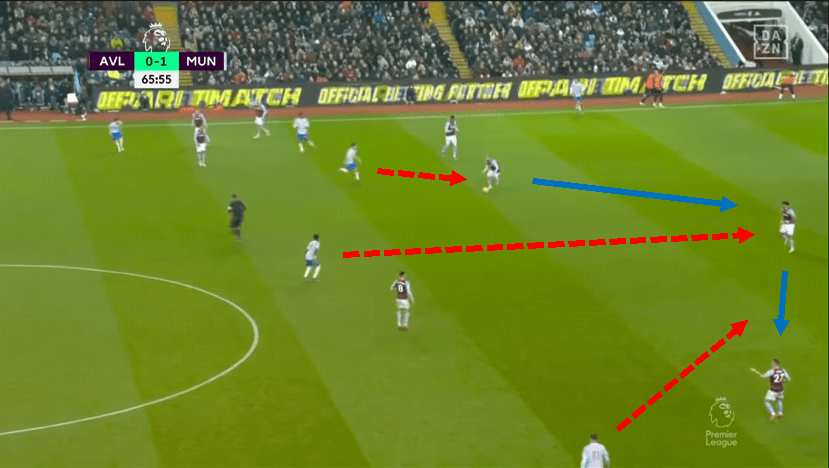
The execution continued through the 67th minute when a phase of collective pressing led to United and Bruno’s second goal. It all starts when Cavani fails a flick on attempt from De Gea’s kick. The counter press immediately starts with Bruno charging at Douglas Luiz, who senses the danger and passes back to Tyrone Mings. Fred then forces Mings to pass it wide to Lucas Digne. Greenwood makes a run to cut off the pass back to Mings to force Digne to pass it forward to Morgan Sanson, but Digne underhits it and Dalot nicks it off Sanson having already been aggressively shadowing him.
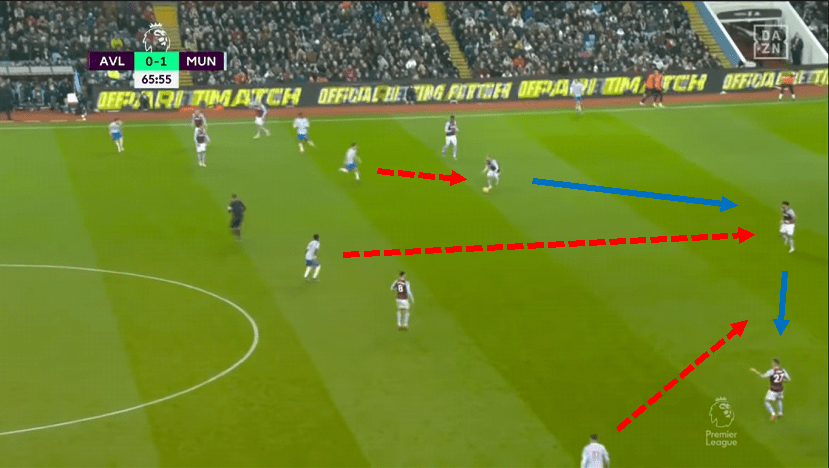
This was almost textbook Rangnick-style counter pressing. United won the ball back 10 seconds after losing it (Rangnick prefers within 8) and got a shot off 5 seconds after winning the ball back (Rangnick prefers within 10).
At this point, many Manchester United fans were thinking the perfect balance was finally struck. A free flowing 4-2-3-1 system centred around Bruno’s ingenuity that defended in a structured and well-drilled 4-5-1. A confident 2-0 win at Villa Park to take three points back home to Manchester. Maybe a stretch, but the around 1,800 traveling away fans may have jinxed it.
Things actually started to slowly unravel even before Villa scored their first goal 10 minutes after United’s second. Longtime Manchester United enemy, Steven Gerrard, made smart changes at halftime. He moved Emi Buendia to the right and Ollie Watkins to the left. This created more balance in the attack as in the first half, Buendia was taking up a lot of space Ramsey and Digne were trying to occupy on the left. With Sanson having a more reserved role opposite Ramsey, Buendia had more space to operate unhindered. Villa started playing quick short passes to pull United players out of position to create pockets of space for attackers to run into.
On Villa’s first goal, it’s Coutinho who attracts four United players before passing to Ramsey with yards of space for a 1v1 against De Gea. Varane shifts to his right to help contain Coutinho and leaves Ramsey unmarked. Varane was forced to shift over because Lindelöf and Matić were pulled out of position from good tight passing from Villa. More importantly, Fred hit the floor earlier in a poor attempt to win the ball off Mings and was left chasing the ball. Bruno shares some blame too as he didn’t track Ramsey’s movement into space with his mind possibly already on a potential counterattack. Like countless times before over the past few years, individual errors caused by lapses in concentration and poor decision making in the defensive third led to conceding a goal.
It’s a similar story for the second Villa goal, but this time, add a pinch of both a literal and figurative hole in the tactics. In this game, Fred acted as a spare man in the midfield three when defending. He alternated between sitting in the defensive shape, and energetically leading the press high up. Many times, Fred took up positions parallel to Cavani as if he were a strike partner, or even beyond Cavani as if he were a lone striker. This left a gaping hole between Matić in the middle and Greenwood on the right. This kept happening, and even more oddly Matić and Bruno weren’t shifting over to cover that hole.
This literal and figurative hole in the tactics was the first error in the 2-2 goal. Fred doesn’t properly cut out Mings’ pass to Watkins, and Lindelöf is dragged forward to challenge Watkins in the space Fred leaves open.
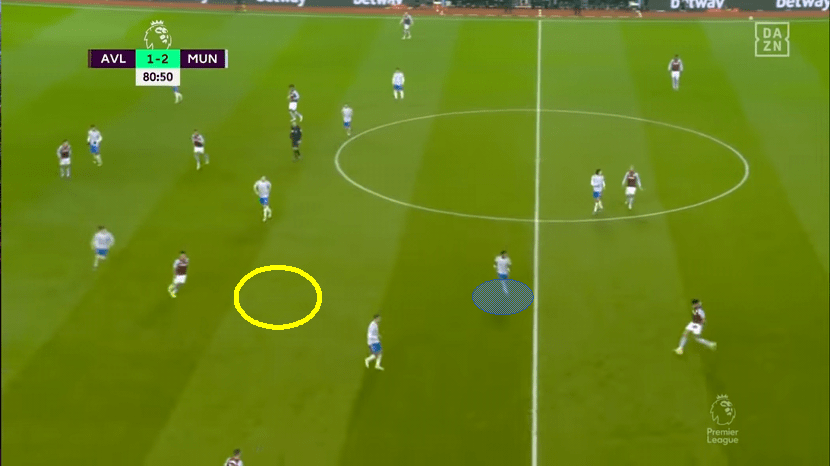
Matić loses a 12-yard dash (wow) to Ramsey who fires a clean cross to a free Coutinho at the back post. Varane missed the interception on the cross that possibly would have resulted in an own goal had he made contact, and Telles doesn’t make an assertive enough effort to get to the ball before Coutinho.
Once again: like countless times before over the past few years, individual errors caused by lapses in concentration and poor decision making in the defensive third led to conceding a goal. On the second goal however, tactical instructions—specifically Fred’s—are also to blame.
It’s hard to say how long this stretch of the 4-2-3-1 will last. Ronaldo should be back from injury against Brentford on Wednesday which means a strike partnership could be required to squeeze both him and one or both of Cavani and Greenwood. It was exciting to be reminded of how effective Fernandes could be when unshackled in attack. It was also informative to see both the positives and negatives of Fernandes in a deeper midfield position.
It will be up to the manager to tweak his approach in search of the right balance between a solid defensive structure, and a free flowing, high flying attack. Hopefully Rangnick can use these two matches to build upon his tactical approach, and to coach some errors out of players. Hopefully these two matches weren’t the best United were going to get because if that’s the case, they’ve run out of Norwegians to make the fall guy.
 The Utility Spot