Instagram: @torontofc
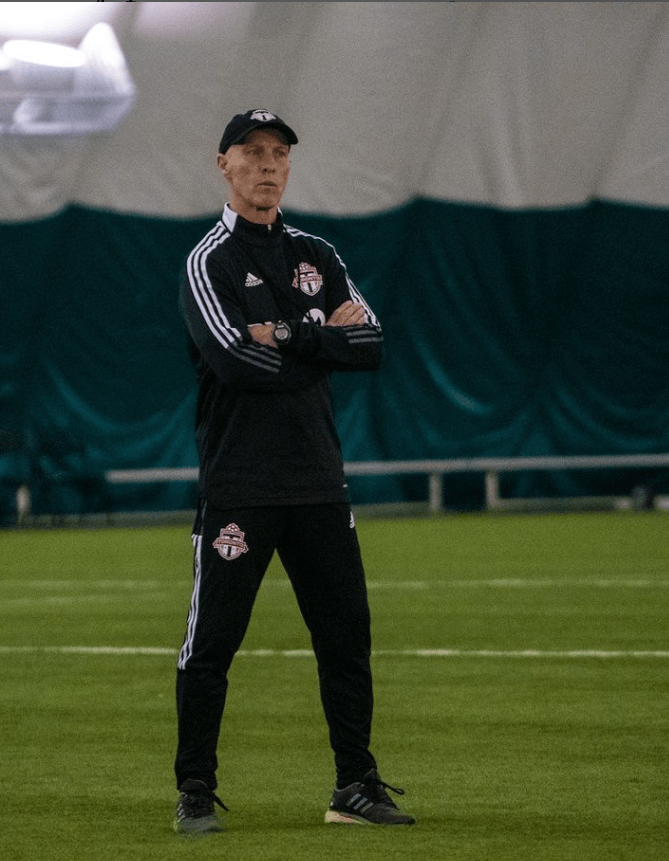
There was some expectation that the hiring of 64-year old Bob Bradley would stabilize a Toronto FC side that crawled to 13th in the Eastern Conference only a year after finishing second in the East, and only two years after claiming runners-up honours in the MLS Cup. Toronto FC’s 2021 campaign was marred with injuries to key players and an incoherence of the tactical style.
The hope going into the 2022 season was that Bradley would settle things at a club with a serious identity crisis. That his long career and relatively many honours for an American coach would bring back the experience of winning. With a 1-1 draw, a 4-1 loss, and a 2-1 loss to start the season, things aren’t looking great… yet.
What Bradley wants out of this Toronto FC side, however, is becoming increasingly clearer with each game.
The Squad
Before discussing what’s starting to develop in this team, there needs to be a look at what’s holding them back.
In the off-season, TFC parted ways with 14 first team players. Three or four (the details of the Yeferson Soteldo transfer are murky) were for fees, Justin Morrow retired, and the rest left on frees or were released from their contracts. Included in the list of 14 were starting XI frequenters Richie Laryea, Marky Delgado, Jozy Altidore, Omar González, Yeferson Soteldo, and Auro Jr. Along with squad players like Tsubasa Endoh, Liam Fraser, and Eriq Zavaleta, TFC—now with Bob Bradley also in a sporting director role—purged an enormous chunk of the squad.
In return, TFC brought in seasoned players in their prime like Jesús Jiménez, Lukas MacNaughton, Shane O’Neill, and Carlos Salcedo, while also promoting Toronto FC II youth like Luca Petrasso, Jahkeele Marshall-Rutty, Jayden Nelson, Noble Okello, and Ralph Priso.
Only including the players mentioned, that’s 17 players out of the first team, and 9 players into the first team squad. Factor in the increased roles of former squad players like Jacob Shaffelburg and soon Ayo Akinola, this Toronto FC side looks little like the short-lived Armas era, and even less like the title winning Vanney era.
This is a lot of turnover in just one off-season—even by MLS standards. The challenge Bradley faces is forming a side from a group of players that have barely played together before. The players that have played together, are taking on a third style of play in three years.
To make matters more difficult, many of the new players are young players who’ve played little to no first division soccer. Shaffelburg (22), Nelson (19), and Marshall-Rutty (17) figure to be crucial figures this season. Across the first three games of the season, Bradley has used eight players 23-years old or younger, including four teenagers.
Not only does Bradley have to implement his style of play with a new squad that lacks cohesion and chemistry, but he also has to integrate very young players that are both exciting, yet raw. So then, what is Bob Bradley trying to implement in this team?
The Attack
Toronto FC fans had to do a double take when they saw the starting lineup for the season opener. Those who wear glasses had to clean their lenses, in case what they were seeing was due to some dust or dirt on their specs. Two wingers at the fullback positions? That can’t be right.
To say this approach is brave is an understatement. TFC conceded the second most goals last season with 66. The next worst record was FC Dallas and Austin FC’s 56. Shaffelburg had never played at fullback in his professional career before this season. Marshall-Rutty only twice. Naturally, you’d expect an approach that emphasizes tightening up the defence, and the deployment of defensively solid, and defensive-minded players in the backline.
What Shaffelburg and Marshall-Rutty lack in their defensive experience, they make up for in their energy down the flanks, and that’s exactly what Bradley wants out of them. Bradley wants the ball to progress forward via the flanks. The fullbacks will play crucial roles in this.
Once the team wins the ball, they work the ball immediately to the nearest flank for the fullback or winger to carry the ball forward. Bradley has instructed his wide players to not pass inside until they’ve crossed the halfway line. The wide players at Bradley’s disposal are quick and good ball carriers, so this instruction suits them. This tactic also reduces the chance of giving the ball away in a dangerous area in central parts of the pitch.
Once past the halfway line, TFC often work the ball inside then out with quick passes. Most of the time, the ball returns to the same flank, but TFC will also flip it to the opposite flank with quick passes rather than long switch passes.
Attacking phases often end in crosses from out wide, or cutbacks from the halfspaces. TFC’s crossing can be greatly improved, but having a target like Jiménez will be useful. Across the three matches, the cutbacks and low crosses from the halfspaces have been much more effective.
This attacking style suits the wealth of wide attacking talent Toronto FC have. The squad is very clearly thinnest in central playmakers. Aside from the mercurial Alejandro Pozuelo, and the flexible Jonathan Osorio, TFC lack any other attacking midfielders. Osorio’s attacking contributions this season have mostly been relegated to late runs into the box from his deeper role in the midfield double pivot. With the number of wide players available, Bradley can alternate frequently as he has been in the four wide positions in this 4-2-3-1 formation.
Pozuelo’s role has changed quite significantly this season. Formerly the central force of Toronto FC’s attack, he’s now an accent point in the attack. Instead of everything going through him, the responsibility to drive the team in transition is more spread out throughout the team. However, Pozuelo still plays a key role in the side as he should, being the technically best player in the squad. In transition, Pozuelo finds himself operating as the deliverer of the key pass leading to a shot (he leads all TFC players in key passes this season with 7), or as a shadow striker going the opposite post as Jiménez to score. The creative Spaniard didn’t look comfortable in his new deeper and more constrained role at the start of the season, but he is growing into it and slowly showing signs of adaptation to the new system. He even has an assist to show for it.
The Defence
TFC are in a similar position defensively as they were last year having conceded the joint third most goals in the league (7). So TFC are shipping goals and they’re playing wingers at fullback. What’s the rationale?
A key player early on has been Luca Petrasso. The silky wide player is naturally a fullback, but has played almost exclusively as a wide midfielder this season. Petrasso and Shaffelburg are beginning to form an effective tandem. Both provide immense energy, workrate, and quality ball carrying. They also compliment each other as Petrasso likes to cut inside into the left half-space, while Shaffelburg prefers to take it down the line to cross it in. When one bombs forward, the other holds back a little. With a better understanding of each other, this combo of essentially two wingbacks will have a good mix of attacking output and defensive solidity. Nelson and Marshall-Rutty provide a similar effect on the right hand side. Initially, deploying two wingers in the two fullback positions seems to be extremely aggressive, but the reality is Bradley is deploying four wingbacks in the four wide positions.
More broadly, TFC defend in a mid-block and press aggressively with Jiménez and one or two other attackers. The press is extra aggressive when Ifunanyachi Achara joins Jiménez, as his pace and energy are non-stop. The rest of the side press more modestly after losing possession to get back into a cohesive shape. This is in stark contrast to the uber aggressive Red Bulls pressing style Chris Armas tried to implement in the team.
When defending in their own third of the pitch, TFC tend to clam up, and the nearest player to the ball will step forward to make a challenge. If the first challenge is lost, the next nearest player will attempt the same thing to dispossess the opposition player. Something significant TFC don’t do is shift to cover up space behind. Failed challenges create gaps in the backline, those gaps become holes in the defence, and those holes form large spaces for the opposition to attack. TFC are particularly susceptible on quick counters due to a combination of inexperienced fullbacks, a very aggressive Salcedo, and a much too slow Michael Bradley.
The Michael Bradley Question
Michael Bradley is of course going to be a major talking point for TFC this season because his father is coaching the team. Michael Bradley is the most experienced player in the side, and also only one of two senior players that can fill one of the double pivot roles—the other being Osorio. His leadership qualities will be integral to a team boasting numerous youngsters.
There’s a duality to Michael Bradley. He’s important to the attack as he can slow things down when needed with his metronomic passing. The range of his passing is also one of the best in the squad. Against FC Dallas and NYRB as a defensive midfielder, he made 5 and 6 progressive passes, respectively. Against Columbus Crew as a centre-back, he completed 10 of 15 long passes, and was charged with initiating attacks with long balls.
At 34 however, Michael Bradley’s days of mopping things up ahead of the backline are over. He is as immobile as he’s ever been in his career, and lacks the physical traits required to be a combative defensive midfielder, or an adept ball carrier. He only made 2 progressive carries, including 1 into the final third, against FC Dallas, and he didn’t make any progressive carries against NYRB or Columbus Crew. He doesn’t stray too far from the backline, but he doesn’t join it when the fullbacks push up either. His role in the attack seems to be the long ball deliverer for when the side decides to switch it up from carrying it forward from the flanks. In defence, his role is to attempt challenges against opposition players. When he loses those challenges, he’s left in the dust and becomes a statuesque bystander.
Okello will be the likely successor to Michael Bradley, and the sooner the better. At 6’4”, he offers a unique physical presence in midfield. Dynamic going forward and retreating, Okello’s physical qualities will be very useful for TFC this season. He’s surprisingly hard to knick the ball off of despite his large frame, and he knows when to release the ball to a teammate if pressure mounts. While his passing can still improve greatly, Osorio can shoulder the brunt of the passing duties in Michael Bradley’s absence.
What Now?
Under Bob Bradley, there is less of a reliance on any single individual player to make things happen for Toronto FC. While the responsibility to make things happen has been spread out more equally, there is a lot of reliance on winning individual battles. In attack, the wide players are instructed to beat defenders on the dribble to progress the ball, and find teammates later in the passage of play. In defence, especially in the defensive third, players have to win 1v1 challenges to regain possession, and the next closest player steps up if the initial challenge is lost.
Bradley is looking to create a physical team that excels on the counter. He’s deployed players that fit this style for the most part. Toronto FC are filled to the brim with exciting, raw talent. The coaching staff will look to hone that rawness, and shape it into effectiveness.
The reliance on winning individual battles is concerning, especially in defence, but hopefully with time, Bradley can implement a more constructive and cohesive system for this young, growing team. The trick will be to strike a balance between creating structure for a solid baseline, while not shackling the bright and exciting attacking talent. Hopefully, Bradley can have Toronto FC running on all cylinders soon before the mood begins to sour and the heads start to drop. Lucky for Bob Bradley, there is a 5’4” care package from Naples arriving later this season…
 The Utility Spot